2
Case Study
Valve Replacement Case Study
Reduce offshore valve replacement downtime with double block and monitor isolation
Non-intrusive double block and monitor isolation technology reduces downtime, product loss, and maintenance cost.
Identify challenges driving offshore valve repair and replacement
As a natural result of use and the unavoidable deterioration of seal material over time, the repair or replacement of valves on offshore natural gas platforms is inevitable.
Often, the need for repair or replacement is identified through planned inspection and testing. Sometimes, however, a valve failure is only discovered when a leak is indicated on platform sensors.
Various types of valves serving different purposes are installed on offshore platforms, including:
- Trap valves: Isolate the launcher and receiver during operations involving the loading or retrieving of pigs, inspection tools, or isolation tools, and keep personnel from being exposed to pipeline content.
- Shutdown valves, including Emergency Shut Down Valves (ESDV): Actuated valves connected to the platform’s control system, allowing a safe and efficient shut down of production if a dangerous situation is detected or in the event of an incident. These valves may generally be installed topside, in the platform riser, or in the pipeline at sea bottom in close proximity to the platform.
- Subsea isolation valves (SSIV): Actuated ball valves or mechanical non-return (clapper) valves that are installed on the seabed in close proximity to the platform.
- Topside piping, valves, and instrumentation: Connected to the main export or import pipeline.
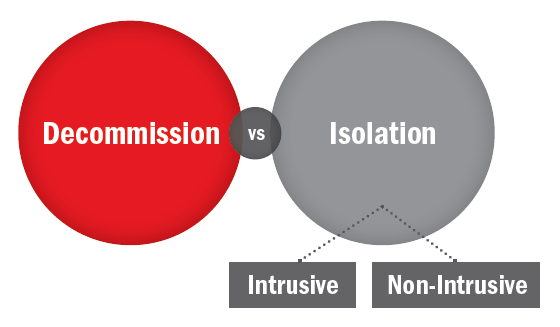
Regardless of the type of valve or its application, replacing it will involve complete removal of the old before installation of the new unit. Repairing in situ may only require taking it apart. Before this work can commence, the pressure and pipeline content (normally hydrocarbons) must be removed from the pipeline or section where the faulty valve is. This can be done by either decommissioning (bleeding down) the entire pipeline and then recommissioning (refilling and restoring pressure) after the work is completed, or by isolating the section where the valve will be repaired or replaced. Depressurization can be costly as valuable production is lost (pipeline inventory plus loss of production during the extended period of time required to depressurize the pipeline). Moreover, the removal of pipeline inventory can create significant environmental challenges, which further escalate the overall costs and complexities of the repair or replacement process.
An alternative to depressurization of the entire pipeline is isolation of the section on which the valve repair or replacement is to be carried out. Localized pipeline isolation offers several advantages as both production downtime and loss of pipeline product are kept to a minimum, with associated environmental and economic benefits. A wide range of methodologies, both intrusive (such as hot tapping and plugging) and non-intrusive (inline plugs, use of inline valves), can be used to isolate pressurized pipeline sections. Both intrusive and non-intrusive methods are well accepted in the industry, with the choice of one over the other being largely governed by factors such as location and accessibility of the pipeline, operating pressures, pipeline inventory, etc.
This paper outlines how non-intrusive double block and monitor plugging technology provides a double barrier isolation for gas export lines during valve replacement, satisfying regulatory requirements and operators’ concerns about safety, time, and cost.
The term “double barrier isolation” is commonly used to refer to an arrangement of two seals in series to isolate a pipeline. In general, barriers are termed double when each can retain the full pressure alone; each is tested; their integrity can be monitored; and they are “independent” of each other. The underlying requirement for a successful double barrier is therefore a system in which the failure of any one seal will not compromise the integrity of the other.
Implement double barrier pipeline isolation to improve worker safety
During pipe repair work where isolation methods are employed, establishing double barriers to safeguard personnel is often required. According to the International Marine Contractors Association (IMCA) D 044 Guidelines for Isolation and Intervention: Diver Access to Subsea Systems, use of double barriers is recommended in all situations where the failure of one barrier may be harmful to personnel:
“For subsea liquid and gas conveying equipment, the general principle is that a minimum of two independent and tested isolations should be established between personnel engaged in any task where the presence of potential hazard from a positive or negative pressure source exists.”
Double barriers for isolating pressurized pipelines can be provided through different arrangements of pipeline valves, flanges, plates, etc., or through the use of inline isolation tools that can seal against the inner wall of a pipeline. The choice of methodology is largely based on detailed risk assessment to ensure that the severity and mitigation of risks are correctly identified and measured. Double block and bleed (DBB), double isolate and bleed (DIB), and double block and monitor (DBM) are commonly used arrangements for providing double barriers in pressurized pipelines.
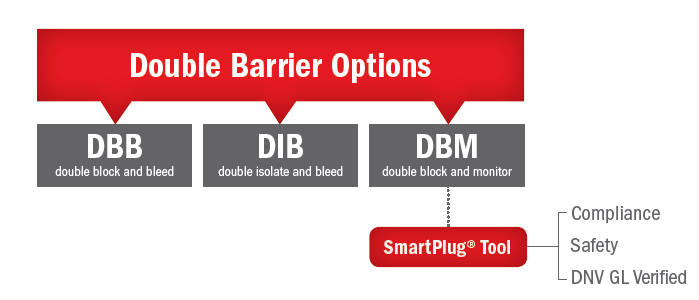
DBM is the principle incorporated into the design of the SmartPlug® pipeline pressure isolation tool, which features two independent plug modules in its standard configuration. This allows the integrity of each seal to be validated at all times by monitoring the pressure in the annulus (between the two plug modules), which represents a significant safety advantage.
The DBM isolation technology behind the SmartPlug tool has been evaluated by Det Norske Veritas Germanischer Lloyds (DNV GL), one of the leading technical assurance, advisory, and risk management companies in the global oil and gas industry, and has been found to satisfy the Safety Class requirements specified in DNV-RP-F113.
Deploy double block and monitor isolation for safer offshore operations
The proprietary SmartPlug tool is a non-intrusive, double block and monitor pipeline pressure isolation solution
that allows any pipeline section to be isolated at, or close to, operating pressure. The modular, self-lock, double block design ensures fail-safe operations in most pipeline media, including gas, crude oil, distillates, treated/untreated water, glycol, and diesel. Articulated modules increase piggability of the bi-directional tool. The standard tool configuration consists of two independent plug modules. These typically travel on a spring loaded wheel system. Each is independently capable of isolating the full pipeline pressure, thus providing a true double-block isolation anywhere in the pipeline system. In some cases, a third plugging module is added for post-repair hydrotesting, using the same tool without retrieving it from the pipeline.
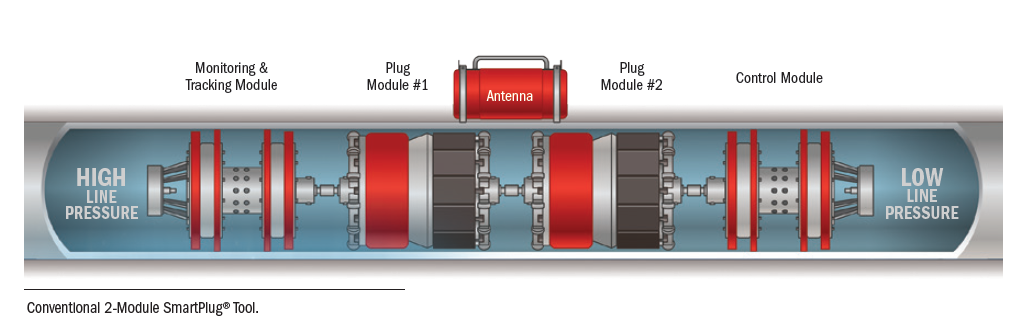
A typical isolation tool has one pig module on each end. These house the onboard control and communication system and assist in driving the tool in and out of the pipeline. The control and communication system communicates wirelessly with the external extremely low frequency (ELF) antenna placed on or above the pipeline.
The standard SmartPlug tool is designed to seal against 250 bar (3,000 psi) operating pressure. The control module (CM) contains the communication and pressure monitoring capabilities, a tracking system interface, battery pack, hydraulic system, and means of contingency unsetting of the tool. The monitoring and tracking module (MTM) is outfitted with a backup pressure monitoring and tracking system together with a battery pack. The MTM may be outfitted with an additional method for contingency unsetting of the tool independent of the CM. Each plug module is designed and tested to seal against the full pipeline differential pressure. The design provides the ability to test the sealing capability of each module.
Execute double block and monitor isolation step by step
Once the SmartPlug tool is launched in the pipeline, it is pigged to the set location using a predefined inert pigging medium such as nitrogen, mono-ethylene glycol (MEG), water, etc. However, production media may also be used, including gas or oil.
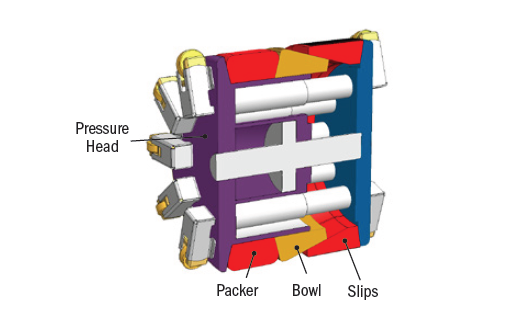
The tool is then activated to set its plug modules one at a time. The plug is actuated (set) by the system applying hydraulic operating pressure to the actuator cylinder. As the actuator cylinder pulls on the actuator flange, the slips are forced up the tapered ramp on the slip bowl and wedged between the outside diameter of the slip bowl and the pipeline inside diameter. Once the slips are in contact with the pipe wall, the movement of the actuator flange against the pressure head will compress the packer radially, expanding it to seal against the inner diameter of the pipeline.
The outer surfaces of the slips are machined with sharp threads to enable the slip teeth to penetrate the surface of the pipeline inner wall in a uniform manner. This penetration depth is well within the tolerances specified by American Petroleum Institute (API) for surface roughness. In fact, engaging only one-third of the slips with the inner diameter of the pipeline is sufficient to provide the gripping effect required for an acceptable isolation.
The annulus pressure between the two plug modules is then monitored for a minimum of 4 hours to confirm sealing of each barrier. Once satisfactory results are obtained and there is no indication of leakage across the two barriers, as determined by the annulus pressure, a certificate is issued to the operator, declaring that the isolation is safe for remedial work to begin.
An important safety feature of the double block and monitor isolation system is that all three pressures (i.e., on the high pressure side, low pressure side, and annulus) are monitored throughout the isolation to confirm the tool’s integrity. The benefits of monitoring the annulus pressure are apparent — due to the very small volume in the annulus, even slight changes in pressure (indicative of leaks) are registered, allowing appropriate action to be taken. With the possible existence of outside ignition sources from “hot work” such as open flames, hot surfaces, unclassified electrical equipment, and worksite personnel, the DBM proves to be a safer option.
Apply double block and monitor isolation in offshore valve replacement projects
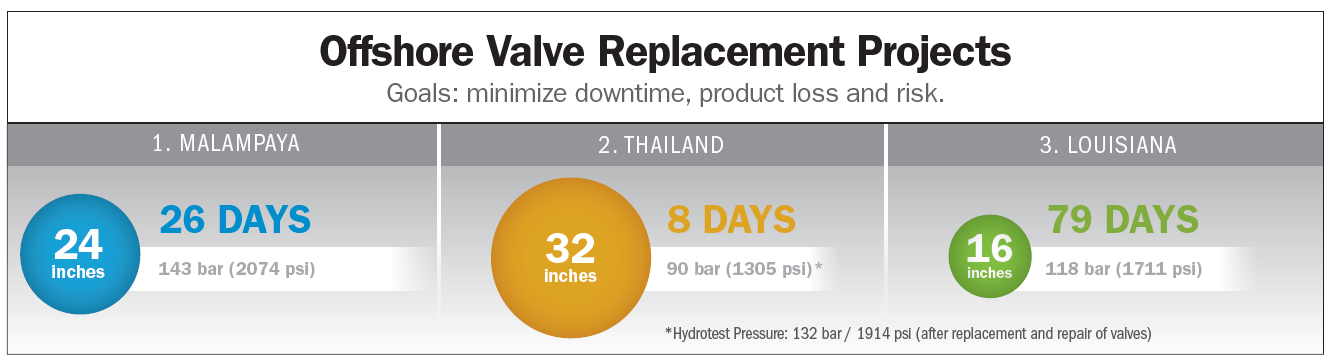
DBM isolation tools have been applied to various offshore valve replacement projects with different levels of urgency, from planned shutdowns to emergency turnarounds. For each, the goals were the same: minimize downtime, product loss, and risk.
- In the case of Shell Philippines Exploration and Production (SPEX), replacing the ESDV and manual block on a 24-inch gas export pipeline to the Onshore Gas Plant at Batangas was part of a scheduled refurbishment of its Malampaya Shallow Water Platform (SWP).
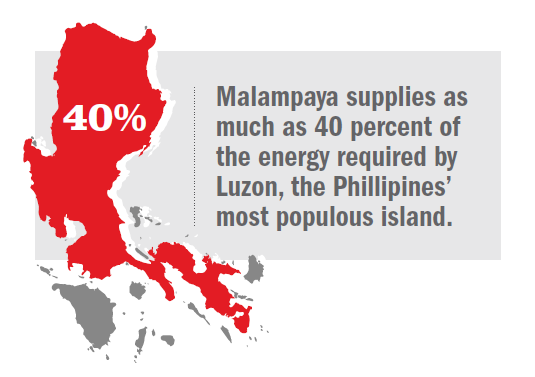
The Malampaya Deep Water Gas to Power Project connects wet-gas flow lines from deepwater subsea wells in the West Philippine Sea to the SWP, where gas and condensate are processed. Dry gas then travels via the 504 km (313 mi) subsea gas export pipeline to the Malampaya Onshore Gas Plant (MOGP) at Batangas for final processing, metering, and dispatch to customers downstream. Malampaya supplies as much as 40 percent of the energy required by Luzon, the Philippines’ most populous island.
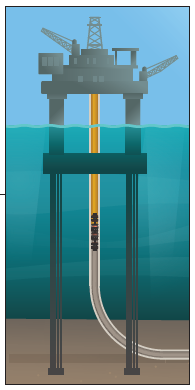
When it was determined that the primary ESDV on the platform riser was defective and no longer able to effectively isolate the platform from product within the gas export line, SPEX decided to remove and replace both the ESDV and neighboring manual block valve. Because gas export is not possible during these repairs, the operation required a planned shutdown.
To help ensure safety and expedience, SPEX chose pressure isolation with SmartPlug technology over a bleed-down of the entire gas export pipeline. This was the first pressure isolation of its kind by SPEX at the Malampaya platform. The successful replacement of the defective ESDV and manual block valve, which restored the integrity safety barrier of the gas export line, was completed well within the project’s tight 30-day window.
- Similarly, PTT Exploration and Production Public Company Limited (PTTEP) faced the replacement of a trio of defective valves identified during a planned inline inspection of a 32-inch gas export pipeline on the Gulf of Thailand Bongkot platform. Problems with the line’s primary shutdown valve (SDV), last manual isolation valve, and one of the two isolation valves for the line’s pig trap were creating both unacceptable internal passing rates and external leakage.
Like SPEX, PTTEP isolated its gas pipeline using SmartPlug double block and monitor technology. Not only was this the first pressure isolation of its kind undertaken by PTTEP at the Bongkot platform, it was the first ever in the Gulf of Thailand.
- Finally, the operator of a Gulf Coast spar platform 320 km (200 mi) off the coast of Louisiana used double block and monitor isolation during the replacement of an ESDV on a 16-inch gas export pipeline riser. The riser was securely isolated against a pressure of 118 bar (1711 psi) and maintained for a period of 79 days.
Plan and execute offshore valve replacement with a structured isolation process
The complete DBM SmartPlug technology deployment process, from planning to execution, includes:
Assess feasibility and verify isolation tool performance
- T.D. Williamson (TDW) conducts an engineering study to determine the feasibility of using the SmartPlug pressure isolation and to verify that the entire operation can be completed within the allotted time frame.
The engineering study includes a site visit; preparation of the design premises; pipe stress calculations; and formulation of operation procedure. This is standard practice, and a requirement set by the Type Approval for deployment of SmartPlug technology. The tool configuration and internal diameters of all pipeline components are reviewed in a piggability study assessing the SmartPlug tool’s ability to negotiate the pipeline to ensure it can be safely pigged to the set location and retrieved back to the launcher. If required, the tool can be pigged forward and retrieved at the other end of the line.
- A full factory acceptance test of each purposebuilt SmartPlug assembly. This test verifies the main functions of the tool, like isolation, control system (set/unset), through-wall communication, proving that the tool is fit for purpose. The test is also witnessed by a third party, traditionally DNV GL. Prior to the factory acceptance test, each individual isolation plug is structure-tested to 1.43x operating pressure in the maximum ID.
Mobilize equipment and personnel for offshore isolation operations
- Equipment mobilization from the most practical and convenient TDW global facilities, leaving sufficient time for onward transportation and preparation at the project site.
- TDW specialists travel to the site to handle the isolation. In general, the TDW crew arrives between a few days and up to a week before the operation commences.
Prepare the pipeline for SmartPlug deployment
- Prior to launching the SmartPlug tool, the launcher is depressurized and opened. The tool
is then loaded into the launcher barrel. The door is closed, and the launcher is pressurized.
Launch and track the SmartPlug tool to the isolation location
- The launcher valve is opened, and the SmartPlug tool is pigged using water, nitrogen, or the export gas to the set location in the riser.
- TDW tracks the tool’s progress with its remotely operated SmartTrack™ tracking and monitoring system.
Set isolation barriers and monitor seal integrity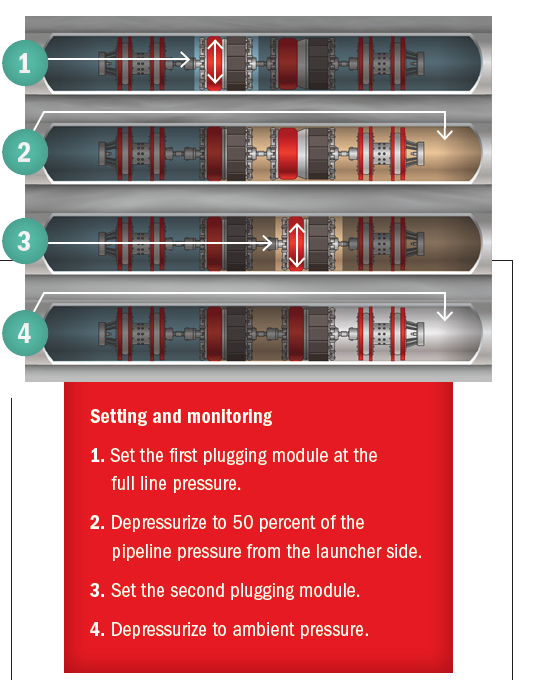
- Upon reaching the set location in the riser, both plug modules of the SmartPlug tool are set in the
sequence. - After the SmartPlug tool is set, the launcher side is depressurized to ambient pressure, and the annulus pressure between the two plugging modules is monitored for four hours to verify the seal. An isolation certificate is then issued to the client declaring that the pipeline isolation is verified and stable for valve replacement to commence.
- The annulus pressure is monitored throughout the isolation to ensure its integrity.
- In most cases, the entire launching operation, including pre-launch activities, pigging, setting, and monitoring, takes less than 24 hours.
- After the isolation tool is set and line safety is verified, valve repair or replacement is performed.
Test repaired valves and retrieve isolation equipment safely
- The newly installed valves are tested to ensure that tightness has been achieved on all sealing surfaces of the flange before it and the pipe are subjected to internal pressure. The method involves pressurizing the annular space above and below the seal ring using a test medium (typically water), but an inert gas (typically nitrogen) can also be used. This allows the joint to be tested as soon as it is made, so that problems can be quickly rectified before the rest of the piping system is installed. This method avoids pressurizing large volumes of piping.
- Upon completion of the test, the SmartPlug tool is unset by running the setting sequence in reverse.
- The tool is then pigged back to the launcher; the launcher valve is closed; the launcher is depressurized; and the SmartPlug tool is retrieved.
- Personnel and equipment are demobilized from the site.
Protect personnel with fail-safe offshore isolation technology
Safety is always critically important in offshore valve repair and replacement. Many TDW clients use a formal
prescriptive procedure designed to provide clear instructions to the equipment users and to safeguard personnel carrying out work activities. The SmartPlug tool is engineered to be self-locked in the set position, providing fail-safe operation as long as there is delta pressure across the plugging tool, even in the event of a communication failure. Delta pressure is monitored through the control system, which provides the operator with all relevant pressures for both the hydraulic system and the pipeline. In addition, alarm switches can be activated to alert the user if annulus pressure exceeds or falls below a preset value. If required, the SmartPlug tool can be unset and recovered with an onboard mechanical fail-safe system without the use of the communication system.
The methodology of using the SmartPlug isolation system has received a Type Approval Certificate from DNV GL and confirming compliance with DNV OS – F101. Included in this certification is a detailed Failure Mode, Effects and Criticality Analysis (FMECA) study and Fault Tree Analysis (FTA).
Increase production efficiency with SmartPlug isolation technology
Offshore valve replacement projects demand a solution that balances safety, operational efficiency, and production continuity. Traditional approaches often require operators to either continue operating with defective valves or depressurize and purge entire gas export lines, both of which can introduce significant operational, environmental, and financial challenges.
The SmartPlug® system provides a fast, reliable alternative to other intrusive and non-intrusive isolation methods by enabling verified double block and monitor (DBM) isolation without requiring full pipeline depressurization. As a result, operators can reduce pipeline downtime, lower maintenance costs, minimize products loss, and improve overall production performance.
Without SmartPlug technology, operator are typically left with two less desirable options:
- Risk operating with defective valves that can create safety hazards and compromise critical isolation barriers.
- Depressurize and purge entire gas export lines, resulting in product loss through flaring, increased environmental concerns, and lengthy recommissioning activties before production can resume.
By allowing maintenance activities to be completed while minimizing disruption to operations, SmartPlug technology helps operators safely return assets to service in significantly less time. In many applications, operations can resume within as little as 24 hours following valve installation and testing, helping reduce the cost and impact of planned maintenance and emergency repairs.
Learn more about SmartPlug® technology
SmartPlug® technology is a proven, DNV-verified pipeline pressure isolation solution designed to help operators safely perform valve replacements, pipeline repairs, tie-ins, and maintenance activities while avoiding the challenges associated with full-system depressurization.
With its non-intrusive double block and monitor design, SmartPlug provides continuous isolation verification, enhanced personnel protection, and reduced production losses across a wide range of offshore and onshore applications.
Learn more about how SmartPlug technology can support safer, faster, and more efficient pipeline maintenance operations.
Interested in keeping a copy of this story for future reference? Download the PDF version of this paper to explore the project details, deployment approach, and results achieved using SmartPlug® isolation technology.