2
Case Study

SmartPlug Non-Intrusive Inline Isolation
SmartPlug® isolation helped safely decommission a North Sea pipeline without shutdown
TDW Offering: Non-Intrusive Inline Isolation for Valve Replacement
Technology: SmartPlug® Non-Intrusive Isolation System (Double Block and Monitor Isolation)
Project Location: Offshore spar platform in Gulf of Mexico, approximately 320 kilometers/200 miles off the coast of Louisiana
In recent years, offshore pipeline operators around the globe have come under intense pressure from regulatory bodies to prove and meticulously maintain the structural integrity of their networks. As a result, improving the efficiency of platform valve replacements has become a top priority.
Executing a valve replacement is a complex operation that requires extreme precision and comprehensive planning to ensure that affected sections of pipe are securely isolated from pressure in the line before work commences. The challenge is to preserve safety while minimizing disruptions in flow.
Several valve isolation options are available to offshore operators. However, non-intrusive inline isolations have become standard due to their excellent safety record and their ability to decrease downtime. As a case in point, we will explore the usage of non-intrusive inline isolation to replace an emergency shutdown valve (ESDV) on a spar platform located in the Gulf of Mexico.
After examining a number of options, including both intrusive and non-intrusive isolation techniques and inert purging, the operator chose a non-intrusive inline isolation using double block and monitor technology. As a result, the multi-valve replacement was executed successfully — safely, on schedule and without having to bleed down the line.
Addressing regulatory compliance on a gas export pipeline
In 2011, the operator of a spar platform located 320 kilometers (200 miles) off the coast of Louisiana made plans to replace an ESDV on a riser gas export pipeline because the valve had reached the critical limit for internal passage. The initial scope of the project included the isolation of a 16-inch riser connected to a subsea pipeline network so the valve could be replaced.
Maintaining safety and production during offshore valve replacement
Although hot tapping and plugging (HT&P) is often used for pipeline isolations, the operator contracted T.D. Williamson (TDW) to develop an alternative approach. TDW is regarded as a full-service provider at the site: The operator uses TDW equipment – including SmartTrap® launchers and receivers, closures, cleaning pigs and pig tracking equipment – and TDW services such as inline inspection (ILI) for integrity management.
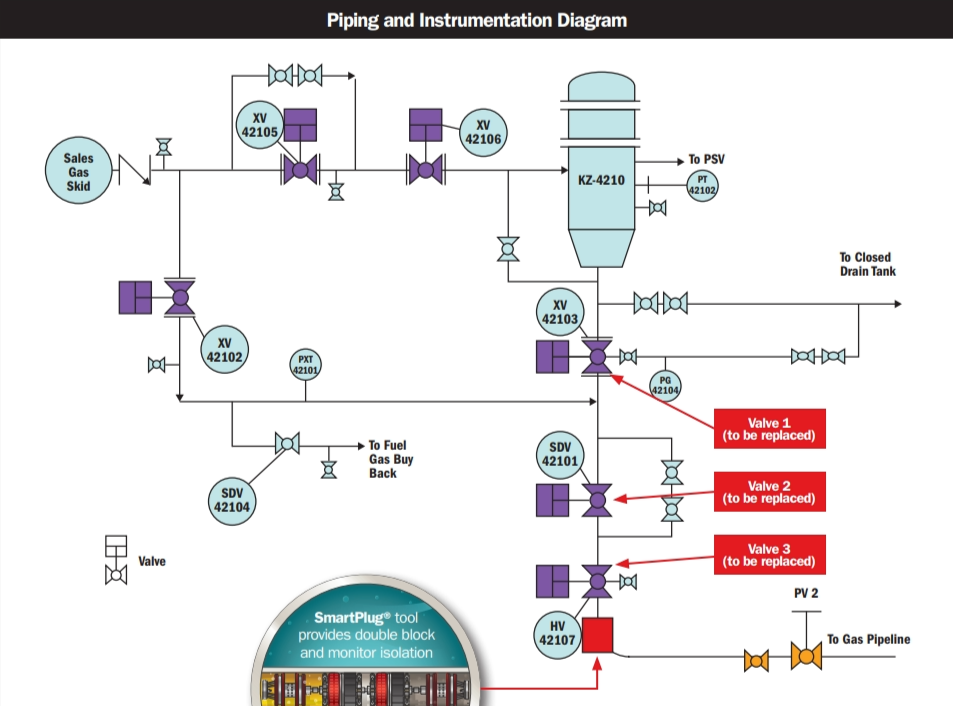
After a series of preliminary risk assessments and piggability tests, the operator made the decision to expand the project scope and use the line isolation as an opportunity to replace two additional valves and install a launcher extension. Adding the extension would expand pigging capabilities by enabling the launcher to accommodate longer tools, thus facilitating future inline inspection tool runs.
Beyond replacing the faulty ESDV for safety purposes, installing the new valves was critical to the operation of the platform due to Bureau of Safety and Environmental Reinforcement (BSSE) regulations that mandate ESDVs close within 45 seconds of emergency shutdown (ESD) or sensor activation. The operator asked T.D. Williamson (TDW) to provide all engineering-related work for the valve replacements, which included collaborating with the operator to select the isolation methodology, along with all necessary inspections and factory acceptance testing (FAT), communications tests and friction pull-tests.
Achieving double barrier compliance with SmartPlug® technology
As is the case with any offshore operation, minimizing loss of production and maintaining the highest level of safety on the platform were critical to successfully executing the valve replacements. Although the ESDV was experiencing an unacceptable internal passage rate, it did not present the same immediate safety threat to the platform or environment that an external leak would have. However, if unaddressed, it could have resulted in a number of regulatory issues for the operator had the passage rate continued to increase.
In order to execute the valve replacements, a number of isolation techniques were considered:
- Due to its impact on downstream operations, fully decommissioning the line and bleeding the affected section of pipe was a last resort for the operator.
- It was determined that inert purging the line would result in more downtime — and cost — than an inline isolation, and because of this, it was removed from consideration.
- A hot tap and bypass solution would have enabled product to continue to flow; however, for additional safety and operational purposes on the platform, it was deemed impractical.
- The operator and TDW decided a non-intrusive, inline isolation utilizing double block and monitor technology would be the best fit for the project.
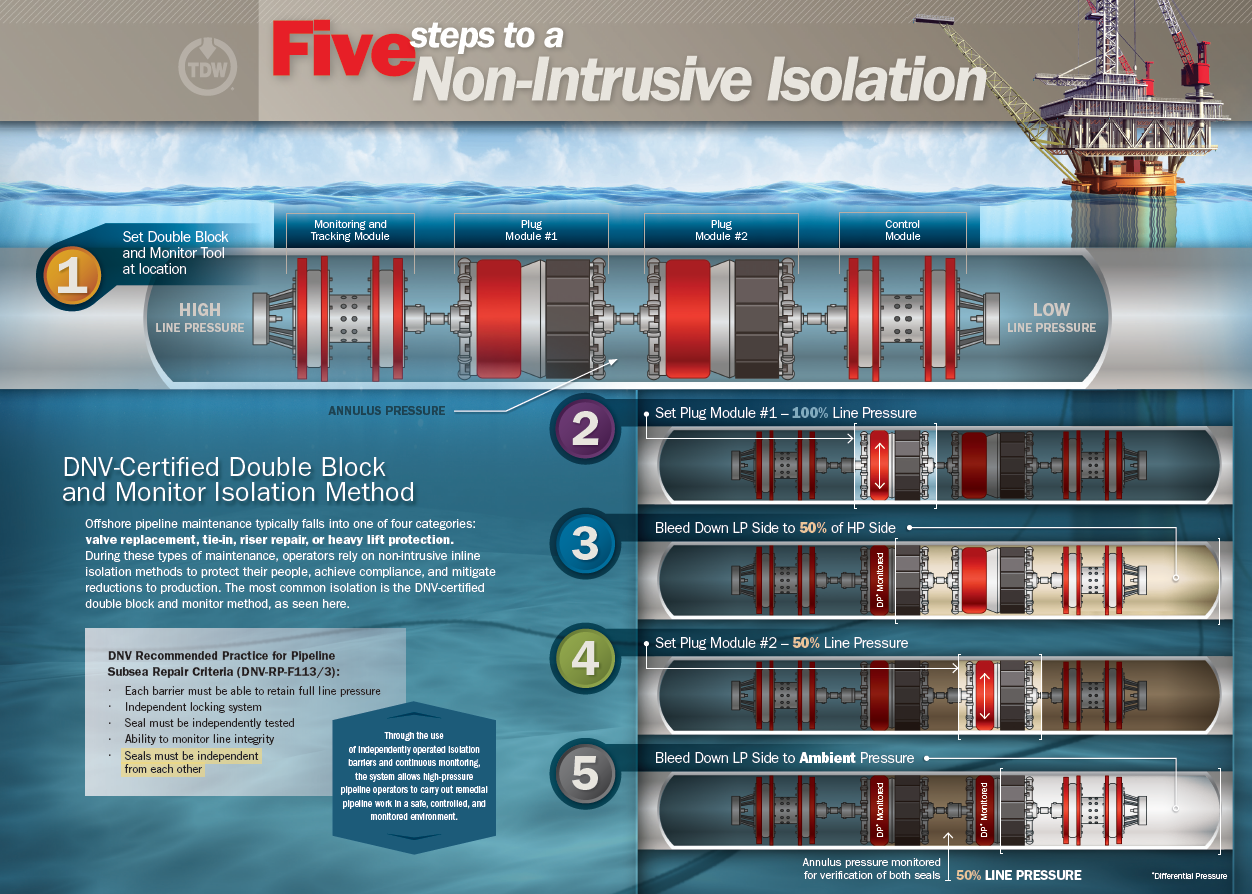
In this context, double block and monitor entails isolating a section of pipe upstream of the valve using two independent plugs/modules. During the process, integrity of the two module seals is tracked by continually monitoring the contained pressure in the annulus. Any fluctuation in annulus pressure will alert personnel if a seal is compromised (see infographic on pg. 4).
This approach avoids the need to vent product within the line and eliminates creation of a potential leak path between the two modules, ensuring that additional risk is not created and the inline isolation remains inherently safe.
To ensure the highest level of safety, it was determined that the double block and monitor methodology used to isolate the gas export line should remain in accordance with all criteria outlined by DNVRP-F113/3 for the definition of a “Double Barrier.”
- Each Barrier Must Retain Full Pressure Alone: Each plug module must be capable of fully isolating the pipeline on its own. In addition, the pipeline stress induced by a single module at full pipeline pressure has to remain within the safety limits of the pipeline operation, to not put the pipeline at risk. (The introduction of a second plug module and the stepping down of the pressure across the two seals spreads the pipeline stress across both modules, further reducing the stress during a full line isolation.)
- Each Plug Must Have an Independent Locking System: Each plug module must have its own locking system (slips). These slips are independent of one another, thus preventing movement within the pipeline and providing individual failsafe operation of each plug module alongside the plug module sealing arrangement (packer).
- Each Plug Must Be Independently Tested: Each plug module has to be independently tested as part of the Factory Acceptance Test (FAT) in a test pipe to 1.43 times the operational pipeline pressure. This test must be witnessed and accepted by DNV GL for third-party verification.
- Each Plug’s Integrity Can Be Monitored: The integrity of each seal must be able to be monitored to ensure a successful isolation.
- Each Plug Must Operate Independent of the Other: Both plug modules must operate independently of each other. They each have to be capable of isolating the pipeline on their own.
Non-Intrusive SmartPlug® isolation supported offshore valve replacement
As the SmartPlug® double block and monitor technology fit DNV-RP-F113/3 criteria, it was chosen as the isolation method for the project.
To ensure that the inline isolation would achieve first-time run success* — which would reduce operational complexity and improve safety during the critical plug setting process — TDW verified the project engineering and performed all necessary communication and pull-tests, and executed in-depth FAT throughout 2012 and 2013. In addition, a comprehensive range of risk and peer reviews (internally and with the operator) were planned and carried out.
The SmartPlug® module’s wide seal profile and short body design — which provided more bend clearance and a larger extrusion gap to help maximize piggability — were also major contributors to first-time run success.
With the possibility of the leaking ESDV failing to meet regulatory function requirements during the preparation period, TDW also maintained a SmartPlug® module and a FAT rig in Houston, where they remained on stand-by in the event they needed to be rapidly deployed. Working in cooperation with the operator’s team, a total of 3,500 hours were invested in preparation for the isolation.
In May 2014, the isolation commenced. With safety as the top priority, all non-essential personnel were transferred from the platform during the launch and setting of the tool. The SmartPlug® tool was then pigged a distance of 18.28 meters (60 feet) into the riser toward its set location.
TDW used the remote-controlled SmartTrack™ tracking and monitoring system — which utilizes an ultra-low frequency transceiver to remotely track the tool’s progress, control its spee and monitor conditions in real time. Upon reaching its location, the tool was set into position, and by 11 p.m. the same night that it was deployed, the isolation was confirmed and certified in accordance with DNV GL requirements.
The riser was securely isolated against a pressure of 118 bar (1711 psi) and maintained for a period of 79 days.
During the isolation, maintaining a 50 percent pressure value in the annulus between the first and second modules allowed for the integrity of both seals in the pipeline to be monitored. Any change in the annulus pressure would alert TDW to a possible breach of integrity of a seal. A positive pressure rise would indicate the second module had allowed passage. A negative change in pressure would indicate a leak across the first module.
During the 11-week span, the three valves were replaced and the launcher extension was installed. Upon completion of these tasks, the isolation tool was safely retrieved and the operation concluded without incident.
Offshore valve replacement was completed safely and efficiently
1. The double block and monitor isolation performed with SmartPlug® technology enabled the safe replacement of three valves on a key section of the platform’s gas export pipeline — without having to bleed down the entire line.
2. A continuous flow through multiple downstream connections was maintained throughout the duration of the project, and loss of production was kept to an absolute minimum.
3. Working in close cooperation, TDW and the operator maintained a high level of communication, making the isolation a first-time run success* and minimizing lost production time.
4. The line isolation made possible with SmartPlug® technology allowed the operator to comply with all DNVRP-F113/3 “Double Barrier” criteria and line isolation requirements.
5. The SmartPlug module’s wide seal profile and short body design allowed for more bend clearance, a larger extrusion gap and maximum piggability. These were major contributors to first-time run success, which shortened the overall duration of the project, improved safety and decreased the complexity of the isolation.
6. The stress/strain applied by the SmartPlug isolation module was less than half of the calculated maximum allowable stress/strain for the pipeline.
7. Installation of the launcher extension greatly enhanced the ability of the operator to conduct future inline inspections by enabling the launcher to accommodate longer tools.
Learn More About SmartPlug® Double Barrier Isolation Solutions
Browse additional case studies to see how operators have used SmartPlug® technology to support offshore maintenance, valve replacement, and isolation projects while maintaining safety, regulatory compliance, and operational continuity.
Download a printable version of this case study here.