2
Case Study
SmartPlug Non-Intrusive Inline Isolation Onshore
Unique services combo, including SmartPlug® technology, enables safe and fast valve replacement
TDW Offering: Non-Intrusive Inline Isolation / Valve Replacement
Technology: SmartPlug® Non-Intrusive Isolation System (with Hot Tap & Bypass)
Project Location: Texas
Liquids management is an ongoing challenge for natural gas operators in the Eagle Ford shale play. Displacing liquids is essential to maintaining throughput, minimizing the potential for corrosion, and providing access to valuable condensates.
To optimize liquids displacement, one operator pigged pipelines with multiple TDW pigs several times a day and frequently ran additional cleaning pigs. But leaking valves jeopardized pigging operations: if the valves degraded to the point where they couldn’t safely seal, pigging would be impossible.
There was no question that the valves needed to be replaced. However, because the pipelines fed three downstream gas plants, the operator couldn’t shut in the system to perform the work. After evaluating a variety of methods used to isolate pipelines during repairs and maintenance, the operator chose a non-intrusive method.
Through the implementation of multiple intervention solutions, including technologies not previously used in tandem, the operator was able to safely and efficiently replace the leaking valves and restore maintenance pigging without the time and expense of blowing down the pipelines.
Maintaining continuous gas flow during critical valve replacement
A Texas pipeline operator performed daily maintenance pigging to displace liquids on two, 24-inch, 100km (62mi) natural gas pipelines located approximately 150m (492ft) apart. The pigging program included launching multiple spheres and other pigs on both lines several times a day. However, when the valves on both the launcher and the receiver began leaking, the operator needed to intervene before the seals failed and it was no longer safe to open or close the trap doors.
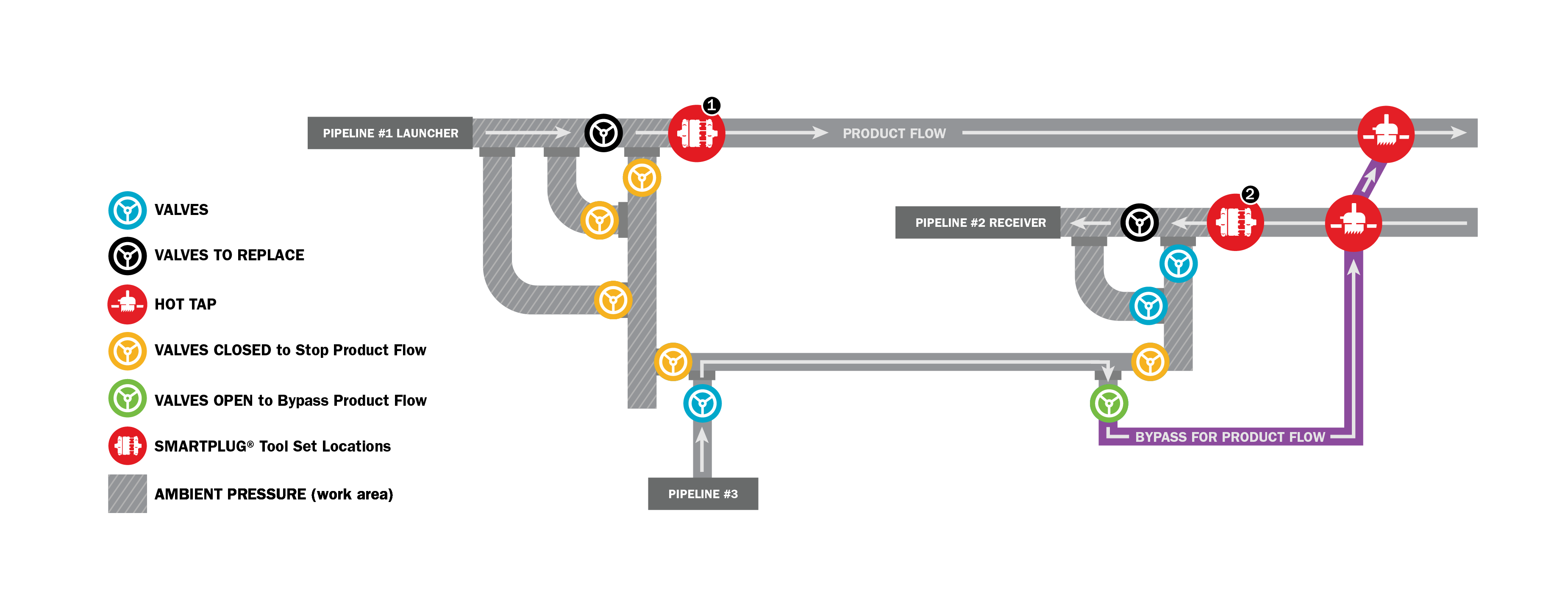
Before the valves could be replaced, the operator needed to isolate the pipelines and connect them to a bypass system that would allow service to continue to three downstream gas plants. Blowing down the system would have been expensive and time-consuming, especially given the pressure (75 bar or 1100 psi) of the product; the gas could have been flared or stored, but those were not attractive options, either. An existing upstream bypass could not be used safely, as it was unable to keep product from reaching the work zone while maintaining downstream production.
SmartPlug® non-intrusive isolation enables safe valve replacement
Although hot tapping and plugging (HT&P) is often used for pipeline isolations, the operator contracted T.D. Williamson (TDW) to develop an alternative approach. TDW is regarded as a full-service provider at the site: The operator uses TDW equipment – including SmartTrap® launchers and receivers, closures, cleaning pigs, and pig tracking equipment – and TDW services such as inline inspection (ILI) for integrity management.
TDW combined SmartPlug® isolation and hot tapping for operational efficiency:
- Hot tapping and bypass
- Integrity management
- Launchers and receivers
- Non-Intrusive inline isolation
- Non-Destructive evaluation
- Isolation
- Cleaning pigs
- Closures
To overcome the challenges of isolating the system without using conventional HT&P, TDW created a total solution that combined hot tapping and its 24-inch SmartPlug® non-intrusive isolation system for pressurized pipelines. This was the first time the two technologies had been used together onshore in the lower 48 states. TDW also provided non-destructive evaluation (NDE) services, including Positive Material Identification (PMI) and ultrasonic wall thickness testing.
The TDW SmartPlug® tool is designed to isolate as a vapor barrier (0 psi) up to differential pressures of 250 bar (3626 psi). It can be used onshore or offshore so equipment maintenance, repairs, and replacements can be done safely without bleeding down the entire system. By keeping hydrocarbons flowing during scheduled or emergency work, operators maintain productivity and profitability while also avoiding the time, expense, and risks of depressurization and recommissioning.
Preparatory steps before deploying the 24-inch SmartPlug® tool:
- Performing NDE to confirm tolerances, pipe size, materials, and wall thickness and to verify maximum isolation pressure.
- Providing 24-inch by 16-inch fittings to enable a permanent bypass between the two pipelines and connection to a third 16-inch pipeline from the metering station.
- Injecting valve sealant into the leaking valves to ensure the safety of the operation. The operator also installed air movers and venting to further mitigate risk.
Because SmartPlug® technology has bi-directional capabilities, it was deployed in the launcher and receiver for each isolation, and retrieved from the same entry point, minimizing pigging time. The tool was first launched from the TDW SmartTrap® automated launcher system and pigged to the set location between the overbend and the sag bend. It isolated the launcher side so the valve could be replaced, then was pigged back through the newly installed valve using gas pressure from the pipeline. Onsite servicing was performed to confirm the full functionality of the tool prior to execution of the subsequent isolation operation. After a complete safety and quality review, the tool was launched from the existing receiver, pigged through the pipeline components, and set to isolate the receiver side so that valve could be replaced.
This was the first time the SmartTrap® automated system was used to launch a SmartPlug® tool, although it was designed with intelligent pigging tools in mind. It has been primarily used to allow multiple urethane pigs to be loaded at one time and released at predetermined intervals.
Non-Intrusive isolation reduced downtime and operational risk
By utilizing the SmartPlug® tool, TDW brought a new inline isolation option to an operator who wanted to work with a reputable brand and reliable technology. The isolation was completed safely and successfully, enabling the operator to keep downstream customers online and avoid production delays or drops.
Proven SmartPlug® Isolation Solutions for Pipeline Maintenance
Read additional case studies to see how SmartPlug® non-intrusive isolation technology has been used to support pipeline maintenance, repairs, replacements, and decommissioning projects across a range of operating environments.
Download a printable version of this case study here.